
Lessons From History

1997 Seems So Long Ago
The honeymoon was soon over
Tony Blair entered Downing Street in May 1997 on a wave of optimism, ending 18 years of Conservative rule with a landslide victory that delivered Labour a 179-seat majority. His “New Labour” project promised modernisation, ‘centrism’, and an end to the party’s old left-wing image.
On the Saturday after the election I went to a comedy gig in Bury - we had just won both Bury seats! The tories had held them since 1983.
As far as live comedy goes it was fine. Then an attack on the two day old government in the form of a joke happened. The defeated tory candidate for Bury North quipped from the seat behind me “you had better get used to this” I smiled and went to look for the bar.
From the outset, Blair faced persistent internal dissent and rebellion from his own backbenchers, compounded by local election setbacks, media hostility, and the profound divisions over the Iraq War.
Remarkably, he still led Labour to three consecutive general election victories the first time the party achieved this feat before handing over to Gordon Brown in 2007. Labour’s subsequent defeat in 2010 marked the end of an era. Blair’s premiership illustrates a leader who navigated party fractures with a combination of charisma, strategic ruthlessness, and appeal to the broader electorate.
Early Cracks: The Benefits Rebellion
Blair’s honeymoon period proved remarkably short. In December 1997, just months after the landslide, the government faced its first major parliamentary rebellion over welfare reform. The issue involved cutting benefits for single parents, specifically abolishing the Lone Parent Premium. This was part of a broader drive to reform the welfare state, encourage work, and control spending hallmarks of New Labour’s “tough love” approach.
The vote on the Social Security Bill triggered significant opposition. Forty-seven Labour MPs voted against the government, with around 100 more abstaining. Several ministers and aides resigned or were sacked, including Alice Mahon, Malcolm Chisholm, and others.
The rebellion, while defeated thanks to the enormous majority, signalled deep unease on the left about Blair’s willingness to target vulnerable groups.
A few weeks later, the wall of David Chaytor’s constituency office had a poster “proud to be one of the ‘47’and nothing about our stunning victory back in May.
Critics saw it as a betrayal of Labour values, marking “the end of Blair’s honeymoon.”
Blair refused to concede, demonstrating a pattern that would define his leadership: standing firm on principle (or political calculation) despite internal uproar. Publicly, Labour’s poll lead remained robust at around 29 points in the aftermath, showing that voter opinion often diverged from activist or backbench sentiment.
Local elections soon amplified these pressures. In 1999, two years into government, Labour suffered heavy losses, shedding roughly 1,100 to 1,150 council seats.
This was a significant mid-term rebuke, with Conservatives making substantial gains. Similar losses occurred in later cycles, such as 2006, where Labour dropped over 300 councillors and control of several councils.
These results reflected discontent over issues like public service delivery, fuel protests, and perceptions of arrogance, yet they did not derail national momentum.
Blair’s team framed them as typical mid-term blues, and the party’s centralised machine and Blair’s personal popularity helped contain the damage.
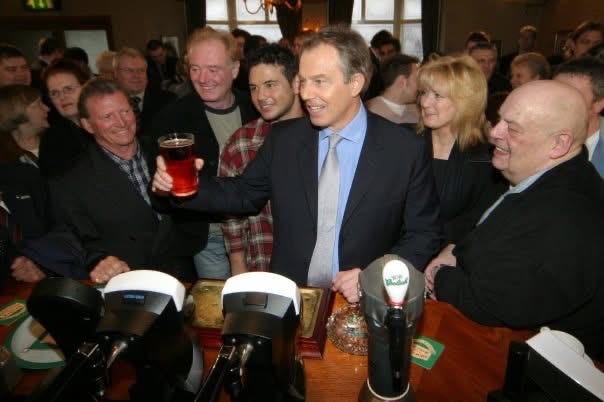
Happy Days - Blair in the set of Coronation Street - I was penned in behind the bar ‘looking after’ the photographers
Escalating Tensions: Iraq and Its Aftermath
The Iraq War became the defining crisis of Blair’s premiership and the focal point of internal revolt. Blair’s close alliance with US President George W. Bush after 9/11, and his conviction that Saddam Hussein posed a threat via weapons of mass destruction (WMD), pushed Britain toward military action despite widespread opposition.
Tensions built throughout 2002.
By early 2003, massive public protests—millions marching in London—and internal Labour unease peaked. In February 2003, a record rebellion saw 199 MPs (including 121 Labour backbenchers) reject the government’s course. A later vote on military action saw 139 Labour MPs defy the whip. This was the largest rebellion in modern parliamentary history for a governing party on such a critical issue. Ministers like Robin Cook resigned, and figures like Clare Short later followed.
Labour conferences saw MPs and staff spat at (and worse). Activists talked about replacing Blair
Hilton Dawson, MP for Lancaster and Wyre, publicly called for Blair to resign if he failed to secure a fresh UN mandate for war.
In March 2003, over 40 Labour MPs signed a letter urging resignation, highlighting how dissent crossed traditional factions.
It made the farce of May 2026 look like an infant school playgound.
Despite this, Blair survived. The government won Commons votes comfortably with Conservative support. Post-invasion realities no WMD found, a bloody insurgency, and rising casualties intensified criticism.
The war eroded Blair’s moral authority, fuelled conspiracy theories, and dominated legacy debates. Tabloid newspapers, initially mixed or supportive during the “dodgy dossier” phase, turned savage. Outlets across the spectrum attacked Blair as “Bliar,” accused him of misleading Parliament, and highlighted the human cost.
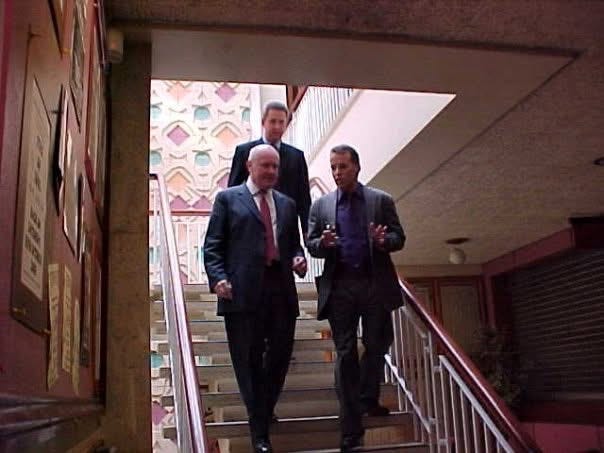
Pic me in north west England explaining to John Reid he was needed in London as Alastair Campbell was about to resign
But it wasn’t just the war….
Right-wing papers later criticised his domestic record, while left-leaning ones never forgave Iraq and joined in the attacks. Blair himself later described the media as a “feral beast.”
Yet, in the 2005 general election, Blair secured a third term. Labour’s majority shrank to 66 seats, reflecting the discontent, but victory was achieved. The Conservatives under Michael Howard failed to capitalise fully, and Liberal Democrats split the anti-war vote. Blair’s personal appeal to swing voters in Middle England, economic stability, and public service investments (NHS, schools) proved decisive despite rebellions.
The Final Push: Watson’s Letter and Brown’s Ascension
By 2006, fatigue and the “TB-GBs” rivalry (tensions between Blair and Chancellor Gordon Brown) dominated. Brownites chafed at Blair’s refusal to set a departure date, despite earlier informal understandings. Local elections continued to show vulnerability, and Iraq’s shadow still lingered. And large numbers of activists apparently decided they preferred opposition to government.
In September 2006, the pressure culminated. Junior Defence Minister Tom Watson and six Parliamentary Private Secretaries resigned in a coordinated move. Watson’s resignation letter was blunt: “It is with the greatest sadness that I have to say that I no longer believe that your remaining in office is in the interest of either the party or the country.” They had signed a round-robin letter demanding a clear timetable for resignation, leaked to the press. Blair denounced Watson as “disloyal, discourteous and wrong,” but the writing was on the wall.
The conference that year was, again a moody affair, with the split in the membership very noticiable.
Blair announced he would step down the following year.
Labour prime minsters don’t happen very often and Blair joined Ramsay McDonald in being brought down by Labour not the tories.
In June 2007, he resigned, and Gordon Brown became Prime Minister unopposed.
Brown inherited a party exhausted by division but with a solid legislative record: minimum wage, devolution, peace in Northern Ireland, and economic growth.
However, the global financial crisis, Brown’s personal style, and the long shadow of activist fatigue contributed to decline.
From visits with ministers being (mainly) happy affairs they became hostile. A personal favourite of mine was an evening meeting in Chester with Charles Clarke where a group, including Labour Cllrs were booing and shouting abuse. Charles looked at me and said “1997 seems so long ago”
In the 2010 general election, Labour lost 91 seats, falling to a hung parliament. David Cameron’s Conservatives formed a coalition with the Liberal Democrats, ending 13 years of Labour rule. Brown resigned as party leader shortly after..
Blair’s Enduring Paradox
Blair’s ability to weather storms remains striking. He faced the largest backbench rebellions in decades, ministerial resignations, local election drubbings, tabloid onslaughts, and open calls for his head (from Dawson to Watson).
His party was often fractious: old left versus modernisers, pacifists versus interventionists, Brownites versus Blairites. Yet he won three elections by maintaining discipline where it mattered, delivering tangible improvements in public services and the economy, and projecting competence and vision to voters beyond Westminster.
Post-2010, Labour struggled to reconcile New Labour’s legacy with its activist base a tension still evident today.
Blair’s tenure offers a masterclass in political resilience. Internal dissent tested him repeatedly, but broad electoral appeal and strategic timing allowed him to govern for a decade.
In the end, the rebellions did not break him; they defined the drama of an era where one man dragged his party to power and held it longer than many thought possible.
I am a lot older now, not necessarily wiser, and I fear history is repeating itself and we have just made the next election harder, not easier to win.
If you got this far - thanks for reading.
As a CLP chair who resigned over Iraq, and still believe that it was the right thing to do, I find the current self-inflicted chaos infuriating. There were genuine moral as well as political concerns about Blair's support for the Iraq war; there is nothing even vaguely similar at present that merits defenestrating a PM. Labour is always an uneasy combination of factions, with a wobbling predominance of one faction over another, often quite radically different ideologically, but this really does not excuse the plotters today. Blair had an energy and charisma, as well as a superbly honed political intelligence that carried him through. Starmer unfortunately lacks that personal charm and stiletto-like ruthlessness; moreover, he is actually quite an inexperienced politician — and it shows.